

If you’re asking whether empathy still matters in business — yes, it does, and more than ever. But companies aren’t built to be empathetic; they’re built to generate wealth. The organizations that treat customer empathy as a strategic growth lever — not a feel-good initiative — are the ones that retain more customers, make better decisions faster, and outlast competitors who mistake short-term cost-cutting for strategy. This post breaks down why empathy keeps getting deprioritized, what that costs companies, and why CX professionals shouldn’t give up on it.
It’s evident today that many companies no longer bother with empathy. They hold no space for it toward their customers or their employees.
And the truth is – we shouldn’t be too surprised. Companies are not human beings. They are wealth-generating entities that take no interest in compassion or care. Never have, never will. They do not side with ‘what is right’ or ‘what is wrong’ in the broader arc of history. They are of the moment, indignantly ignorant of the future repercussions of today’s actions.
People, however, are future-thinking creatures. We are legacy builders. We are planners. We love logic and reason to the point that, in their absence, we’ll create rich fictions and false narratives (à la conspiracy theories) to fill in the blanks and make sense of the world we live in. And now that we live in a post-truth era, more and more people are using their imagination to explain the sad state of…

It was a blast for a while when organizations allowed remote work and incorporated more (performative or not) diversity, equity, inclusion, and belonging initiatives. However, I don’t know that any of these things would have occurred naturally without a pandemic and social unrest.
Organizations that haven’t fully rolled back any semblance of progressive, empathy-forward policies are primarily (underfunded) non-profits and some government agencies. Some large multinational conglomerates are holding the line, saying they have no intent on rolling back DEI efforts – but how meaningful are the programs they have in place?
Regardless of whether it’s for-profit or not-for-profit status, a company’s compassion is the first thing to go when there’s a cash crunch. We’ve always known that – that’s not new.
Why Companies Are Abandoning Empathy (And Why It’s Backfiring)
I see so many LinkedIn posts where individuals question the viability of their careers, particularly those in fields whose focus or discipline centers on empathy, understanding others, and collaborating with broader groups to develop better solutions. The last decade was a boon for UI/UX researchers, designers, product managers, CX professionals, and more customer-centric marketers.
It felt like we reached a moment when companies acknowledged that a deeper understanding of their customers could pay long-term dividends. There was a benefit to talking to customers: understanding the context of how they solved problems in their day-to-day and what companies could do (ideally, easily and quickly) to help those people, ultimately reducing obtuse decisions made in the absence of data, context, or clarity.
With that, companies realized that many traditional roles within an organization lacked a mental model for incorporating empathy or understanding into their roles or business functions.
There was a boon in hiring people whose education, skills, expertise, and learning could bridge the gap between what a company thinks it is, what it does, and what people experience when buying goods or services.
However, the problem was that many organizations did not know how to scale that learning to make it effective within the constraints of the business operations.
We said we did the things and checked the boxes, but most of the time, the organization couldn’t move beyond its old ways of working to benefit from the talent and information these new roles brought to the table.
Customers Are the Final Judges — And Companies Keep Losing Their Case
I wanted to illustrate the core conflict between companies and customers in the image I whipped up below. Companies spend a lot of time and money developing a sense of their identity. Defining who they think they are, who they think they’re making products or services for, who and where they will make money from, and how they behave, rooted in core beliefs, values, or principles, which tend to be generic and hardly differentiated from others.
That is, until they adjust their behavior to live truthfully in line with those values.
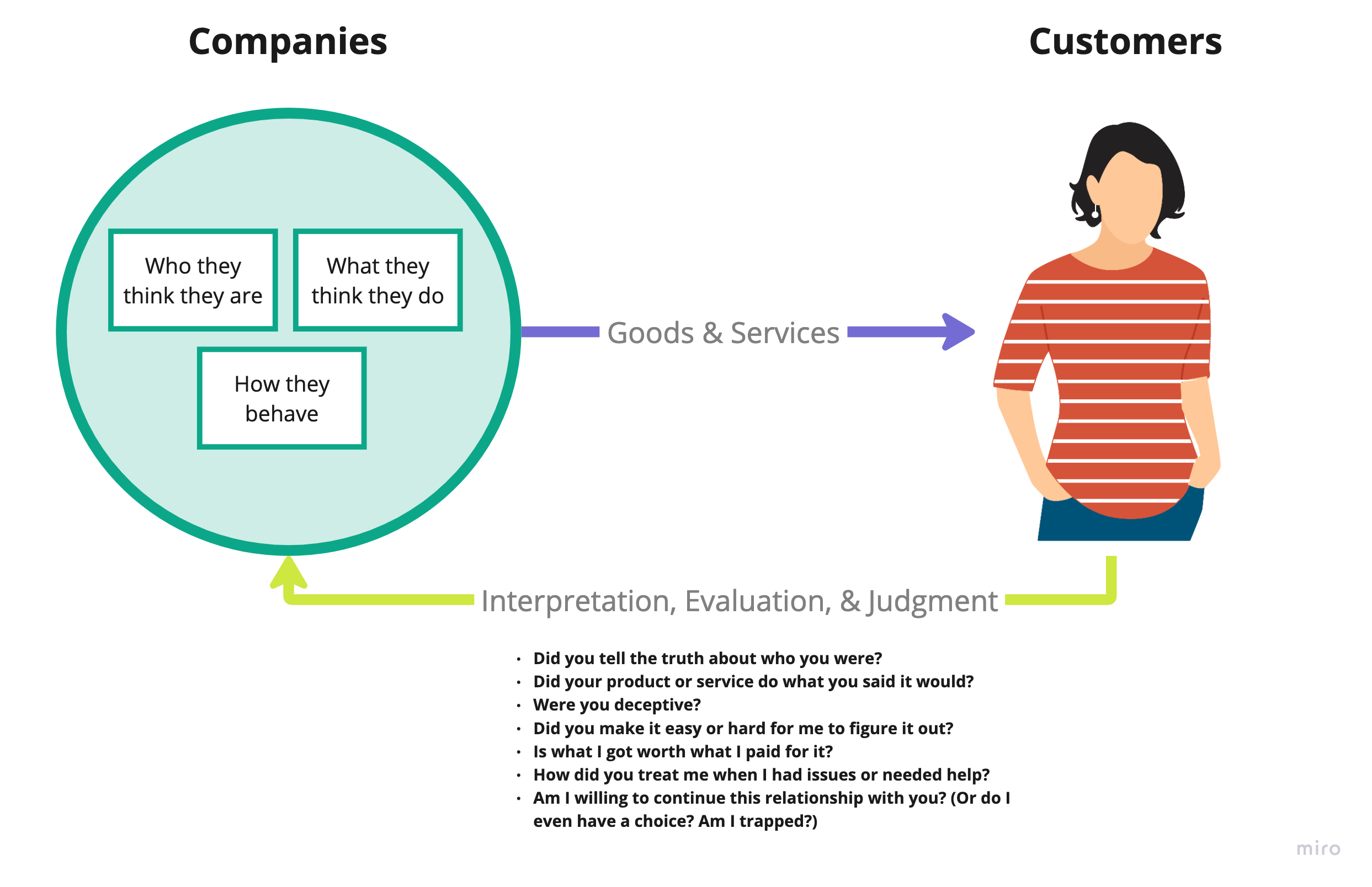
On the other hand, customers have no such concrete sense of self. They usually face a problem they need to solve and turn to companies to alleviate their pain or frustration by using goods or services in exchange for money.
No company is that special, and people develop their own criteria for evaluating and choosing the one that seems less likely to screw them over or fail them in a time of need. In a sea of the same, customers do as much background research as possible to make a highly educated guess that still feels like an acceptable risk.
Customers are the ultimate arbitrators and interpreters of a company’s identity and worthiness. Did the customer feel the company was who they said it was? Did they deliver what they promised or what was expected? Did the company even set clear expectations for the customer, or were they purposely vague and now seem untrustworthy?
When companies are willing and able to close the feedback loop of “Intention > Action > Interpretation of Action > Modify Action,” they create more authenticity between who they say they are. What they do with a customer’s experience is they experience market agility.
Those with their heads buried in the sand, either unwilling or unable (and let’s be honest, it’s more of the former than the latter) to see themselves through the eyes of the real people they serve, remain stuck, and eventually become Sears.
The Real Reason CX Roles Get Cut (And Why It’s a Mistake)
The problem was and remains: I don’t think companies know how to organize themselves effectively around this type of learning. And because they are unsure how to infuse that learning into the traditional measures of success or how to tie it together, these functions and roles within a company feel redundant and invaluable.
The problem is twofold: nobody knows how to tie the power of empathy and understanding back to the balance sheet.
It’s partly the fault of how specific empathy-forward roles have come to exist, focusing so much on theoretical discipline without a grounding in economic realities. But it’s also the fault of companies that don’t specifically outline their strategy and goals. It makes it clear that all people – regardless of role or function – must ladder up to the larger entity’s performance measurement strategy.
The other problem is that the horizons and timelines are incongruent. While learning and understanding take time (even for lightweight research), companies have traded in long-term visioning and growth planning for MoM or QoQ storm-chasing. That means the company wants to pivot quickly, which may not afford people in empathy or human-centered design roles enough time to uncover sufficient insight to prompt a discussion or decision.
With a ton of overhead, companies have been shedding these roles because they see no value in them or believe they can be replaced by cheaper technology.
However, companies must clearly define the problem they want to solve, whether by employing people or technology. Most still struggle with that. So, without an apparent problem, no amount of guessing by people or technology will provide a satisfactory outcome. That’s also why you need PEOPLE to keep double-diamonding the shit out of the jargon that comes out in meetings.
The less specific or concrete we are with how we talk about the problems we face, the less specific or concrete our solutions will be.
How to Tie Empathy to the Balance Sheet: The Business Case for CX
For me, the state of CX is pretty sad. Some days it feels hopeless to be so passionate about this work. Many former CX professionals are moving into self-employed consulting, which I interpret as an echo chamber of people all saying the same thing, but trying to differentiate their thought leadership in some way. It’s an echo chamber of CX professionals talking to other CX professionals. It IS the meme of multiple Spider-Men pointing at one another.
I rarely find actual practitioners doing the grueling, foundational, real CX work.
What do I mean by real CX work? Well, I mean everything beyond running an NPS or CSAT survey and churning out the results in a deck nobody looks at. Building a vision, getting leaders bought in, and understanding the employee experience across teams, departments, or divisions. Understanding how the business model ACTUALLY operates day-to-day and the associated costs of labor and technology (much less vendors et al.).
The problem is that companies don’t seem to care about or understand the value a CX leader (or a tiny team) can deliver.
To me, the work of a CX leader is to help people understand what CX is and its value as a measure of your strategies. There may also be hard conversations where it becomes evident that no real strategy is in place. There may only be hubris and once-in-a-lifetime organic growth. My favorite moments in my career have been sitting with much more educated people in a room and asking questions like, “This is how we behave and how we’re perceived. Is that acceptable to those of us sitting in this room?” Or “If this revenue went away, how will we stay in business for another year, 3 years, 5 years? Where do we lack information to explore other opportunities?”
Customer Experience doesn’t just measure the gap between who a company thinks it is, how it behaves, and how customers perceive and respond to that behavior. It prompts deep discussion around strategy, long-term viability, and how the organizational model requires evolution to continue working.
What CX Professionals Should Do Right Now

In that regard, I don’t think empathy goes away – but I think we as human-centered strategists, regardless of our roles, must prioritize who we have empathy for.
Often, our work is spurring more significant conversations around a realignment of organizational health measurement. It’s about breaking down the traditional siloes of departments and teams and the historical structures of business departments to orient the work of people around the collective view of customers as assets on a balance sheet that can increase or decrease in both quantity and value.
We are catalysts for turning vast amounts of dissonant and disparate data into critical information that advises, arms, and enables leaders with better insights to improve decision-making.
And within that, there’s a ton of work around education, business literacy, communication, change management, and ultimately, determining which insights drive decision-making, prioritization, and competitive advantage innovation.
The reality is that companies today still want what they’ve always wanted – a way to win more, faster, with less cost. Customer insights can give you clues on achieving objectives that satisfy their needs in an evolving marketplace while allowing organizations to respond more proactively to potential opportunities.
And the truth is – we cannot do CX properly without looking at employees’ experience and what constraints they operate under in trying to do their best, either for themselves or their customers. That’s a whole other post.
This is why I complain about CX roles I see that are call center managers or survey programmers. People want the tactical execution of what they think CX is – they have not had someone explain to them or show them with the back-of-the-napkin math how CX can expedite the achievement of revenue growth, revenue retention, and cost reduction.
I saw a post by Phoenix Normand that I loved. What he describes is exactly how I have talked about and pitched CX as a pillar of your business, but one that is more black ops than a traditional function:

The challenge we all face is that leaders view these roles as unnecessary or expensive because they have no connectivity to ROI. Well, make them!
Figure it out together with the person you hire! I’m willing to bet this person will gladly accept that challenge and repeatedly tell you how much these efforts have either increased the customer assets in quantity and/or value or reduced operating costs while maintaining customer satisfaction and brand advocacy.
Empathy Is Still a Competitive Advantage
To those who feel unsure of their career or where it might be going, don’t lose sight of what you offer the world. It’s a unique perspective that reminds us all that no matter how much programming we put into place. Human beings are fickle and indecisive. I should know – I am one!
Because of this complexity, there is immeasurable insight to be gained by listening, understanding, talking, creating, collaborating, and connecting.
We’re on a pendulum right now, and the trajectory feels cold, distant, and closed off. Things feel more ‘us vs them’ and individualism instead of collective unity.
But the thing about pendulums, they never stop moving. Be patient. Do what you need to survive, keep food on the table, put a roof over your head, and keep your family warm and healthy. Nobody is judging you for what you must do to survive, and don’t lose confidence or faith in the successes of your past – it may just take longer to find someone who knows or is willing to take the risk that empathy is good for business.
Why don’t companies prioritize empathy toward customers?
Companies are wealth-generating entities, not human ones. When budgets tighten, empathy-forward programs — DEI, CX teams, VoC initiatives — are among the first to be cut because leaders struggle to connect them directly to revenue. The real problem isn’t that empathy doesn’t generate ROI; it’s that most organizations haven’t built the measurement infrastructure to prove it.
What is the business case for customer empathy?
Customer empathy — understanding why customers behave the way they do, what problems they’re trying to solve, and where your organization fails them — directly drives revenue retention, acquisition efficiency, and product-market fit. Companies that close the feedback loop between customer experience and internal decision-making outpace those that don’t. CX isn’t a cost center; it’s a diagnostic layer that tells you where you’re bleeding money and why.
Is CX dead as a function?
No — but the way it’s been practiced often is. Sending NPS surveys and churning out decks nobody reads isn’t CX strategy. Real CX work is organizational: it connects customer insights to business decisions, helps leaders understand the gap between who they think they are and who customers experience them as, and creates the feedback loops that drive agility. That work is more valuable than ever — it’s just harder to sell internally without someone who can tie it to the P&L.
How can CX professionals demonstrate ROI?
The simplest frame: show how CX insight either increases the quantity or value of customer assets on the balance sheet or reduces operating costs while maintaining satisfaction. For me, CX is a measure of deeper problem discovery and understanding – it’s not a ‘we must do this to have CX.’ It’s a matter of how your organizations want to view business challenges through a more objective lens that understands how a system has been designed (intentional or not) and how it can be improved to deliver better outcomes for both customers and the business.
If you want to talk through what this looks like for your company specifically, the first conversation is free. I’ll tell you honestly where you are in the build and what the most important first move is. Here’s an overview of how I work.